

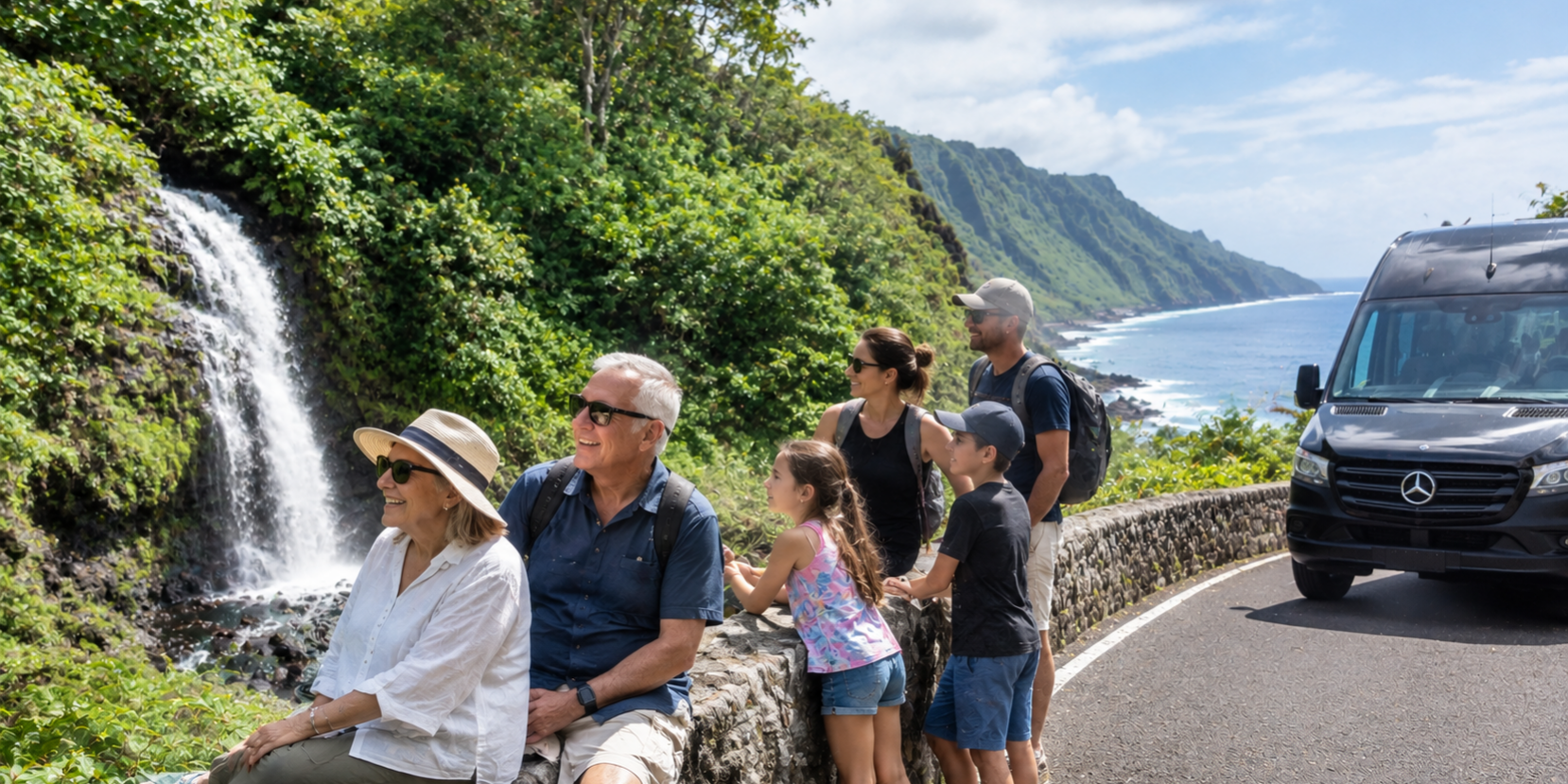
Yes, the Road to Hana, Maui, can be safe and easy for seniors and families when you plan, pick easy stops, and consider a guided tour instead of driving yourself. The road has narrow turns that can feel hard for some drivers. A trained guide, a comfy van, and planned stops can make the trip easier for older adults and kids.
This guide answers the biggest questions about Maui road trip: road safety, easy stops, restrooms, pacing, and emergency help.
What Is the Road to Hana?
The Road to Hana is a 64-mile scenic road on Maui’s northeast coast. It is also called Hawaii Route 360. It runs from Kahului to the town of Hana. The road passes through green rainforest and along ocean cliffs. Along the way, you can see waterfalls on Road to Hana, black-sand beaches, and scenic lookouts. A full round-trip Road to Hana waterfalls tour usually takes 9 to 10 hours with stops. The Road to Hana, Maui, is known for its beauty. It is also known for sharp turns and narrow spots. These are the top concerns for older travelers and families with young kids.
Is the Drive Physically Demanding or Unsafe for Older Adults?
The Road to Hana has real challenges. It has over 600 curves, more than 50 one-lane bridges, and some spots with no guardrails. These features can cause motion sickness, tiredness, or stress. This is most true for people who drive themselves. Your risk depends on your driving skill, your vehicle, and how your body handles motion. Here are the key stress points:
- 600+ curves: Many turns in a row can cause motion sickness. This is worse if you look at a map or phone while moving.
- 50+ one-lane bridges: Each bridge needs the driver to stop, wait, or time the crossing. This adds pressure for drivers who don’t know the road.
- Limited guardrails: Some cliff areas have thin or no barriers. This can feel scary for some passengers.
- Narrow shoulders: Many parts of the road have no space to pull over. You can only stop at marked spots.
If you have balance issues, motion sickness, or driving anxiety, these road features matter more than the total distance. One good fix is to let a guide drive. This takes the stress of driving and navigating off your plate on this stretch of Road to Hana, Maui.
How Does Taking a Guided Tour Compare to Self-Driving for Safety and Stress?
A guided tour removes the need to drive or navigate. Many travelers say this lowers stress compared to driving a rental car. Stardust Hawaii’s Road to Hana Waterfalls Tour uses Mercedes Sprinter vans. These vans are different from a normal rental car in several ways:
| Factor | Self-Driving (Rental Car) | Guided Tour (Mercedes Sprinter Van) |
|---|---|---|
| Navigation | You find the route while also driving | A local driver handles the route for you |
| Seat height | Standard car-level seats | Higher seats for better views |
| Motion sickness | Driving and map-checking may raise the risk | You don’t have to drive or check maps |
| One-lane bridges | You judge each crossing alone | A trained driver handles each crossing |
| Stops | You must plan and research stops | Stops are already planned for you |
| Driver fatigue | One person drives for 9-10 hours | No passenger has to drive |
The Sprinter van’s higher seats give you a better view of waterfalls and coastline. This helps seniors and shorter riders see more, without straining. Stardust Hawaii’s drivers know the one-lane bridges and safe pull-off spots along the Road to Hana, Maui. This cuts down on the guesswork that self-drivers often face.
Do You Have to Do Strenuous Hiking to See the Highlights?
No, you do not need to hike hard to see many of the best waterfalls on Road to Hana. Several top waterfalls are easy to reach with short, flat paths. Here are some easy options:
- Twin Falls: Has a short, mostly flat path to the lower falls. A longer, harder trail is also there if you want it.
- Wailua Falls: You can see it right from the roadside. No hiking is needed.
- Upper Waikani Falls (Three Bears Falls): You can view it from a pull-off spot right by the road.
At most stops, your group can split up. Some family members can stay by the road and enjoy the view. Others can take a short optional trail. This choice is one reason small-group tours work well for families of all ages visiting the waterfalls on Road to Hana. No one is forced to do the same activity.
Are the Stops Wheelchair, Cane, or Walker Accessible?
Some stops are easy for wheelchairs, canes, and walkers. Others have uneven or rough ground. Here are some of the easier stops:
- Ho’okipa Lookout: A paved area with parking close to the view. You can watch sea turtles and windsurfers without walking on rough ground.
- Ke’anae Peninsula: Has fairly flat, open ground near the coast and an old church. Not all of it is paved.
- Garden of Eden Arboretum: Has clear paths, though some parts have a gentle slope.
Not every stop is easy to access. Some waterfall spots need you to walk on rocky or unpaved ground. This is one reason a guided tour helps. Guides know which stops work best for canes, walkers, or wheelchairs on the Road to Hana, Maui. They can choose those stops for you instead of leaving it to chance.
How Frequent and Accessible Are Restrooms Along the Route?
Restrooms are spaced out along the Road to Hana, and some stretches can go 20 to 30 minutes without one. You’ll find public restrooms at some state parks, some waterfall stops, and in the town of Hana. Because the spacing is uneven, planning matters for seniors and young kids. A tour itinerary is usually built around known restroom stops. This cuts down on the guesswork you’d face while driving yourself.
How Are Varying Pace Needs Managed for Kids vs. Seniors?
Pacing for kids and seniors is managed with planned breaks, flexible stop options, and a set schedule instead of a rigid plan. Over a 9- to 10-hour Maui road trip, both kids and seniors can get tired, just at different times. Common ways to manage pace include:
- Planned stops roughly every 30 to 45 minutes for stretching and restroom breaks.
- Optional activities at each stop, so some people can take a short trail while others rest at the main view.
- A set lunch stop to help keep energy levels steady for everyone.
- A planned return time to avoid driving after dark on unlit roads with weak cell service.
On Stardust Hawaii’s small-group tours, one trained driver-guide sets the pace for the day based on the group’s needs. This is different from a self-driving trip, which often tries to fit in as many stops as possible in the least time.
What Precautions Are in Place for Medical Concerns or Emergency Situations?
Guided tours help with emergencies through driver knowledge of the route, awareness of cell service, and group travel. Still, no tour can remove all risks of a remote highway. Here are the key safety factors on the Road to Hana, where some areas have weak or no cell service:
- Driver knowledge: A local, trained driver usually knows which parts of the road have cell service. They plan stops with this in mind.
- Group travel: Riding with other people in a van, instead of alone in a rental car, means help is nearby if someone feels sick.
- Set schedule: A planned itinerary with regular breaks can help lower the risk of dehydration or tiredness on a long trip.
If you have a health condition, talk to your doctor before a full-day trip. Bring any medicine you need. Tell your tour company about any health concerns ahead of time, just as you would for any long trip in a remote area.
Road to Hana Safety: Quick Reference Summary
- The Road to Hana, Maui, has 600+ curves and 50+ one-lane bridges. These are common challenges for self-drivers.
- Mercedes Sprinter vans offer higher seats and take away the need to drive. This can lower travel stress.
- Many top waterfalls on Road to Hana, like Wailua Falls and Upper Waikani Falls, are easy to see from the road. No hiking is needed.
- Accessibility varies by stop. Places like Ho’okipa Lookout have paved, easy access.
- Restroom spacing is uneven. This is why tours plan stops around known facilities.
- Flexible pacing lets kids and seniors enjoy the same trip at their own comfort level.
Why Choose Stardust Hawaii for the Road to Hana?
Stardust Hawaii’s Famous Road to Hana Waterfalls Tour with Lunch is built to handle the road conditions, access needs, and pacing concerns covered above. The tour uses Mercedes Sprinter vans with high seating. Local, trained drivers lead the way and know the curves and bridges of the Road to Hana, Maui, well. The trip follows a paced plan with easy stops at the best waterfalls on Road to Hana, scenic views, and lunch included. Grandparents, parents, and kids can all join the same tour. Each person can choose their own activity level at each stop, instead of doing the same thing.
Families planning a Road to Hana tour can see full tour details, times, and stops on the Stardust Hawaii Website.