

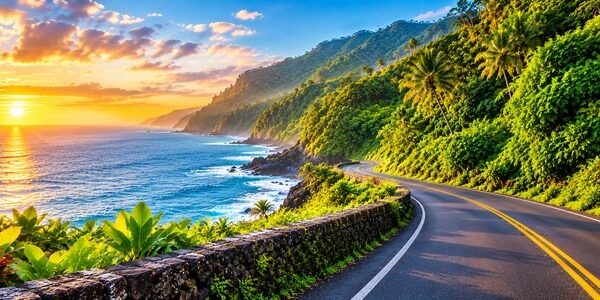
Leave by 6 a.m. On a Maui road trip to Hana, an early start gets you to the best stops before the tour vans and rental cars arrive. Most visitors begin between 7:00 and 10:30 a.m. That 1-4 hour head start is the difference between a quiet waterfall and a packed parking lot.
What an early start gets you:
- Open parking at busy stops
- Smaller crowds at waterfalls, lookouts, and trails
- Calmer one-lane bridges
- Softer light for photos
- Extra daylight for the drive back
What Is Hana, and Why Does Everyone Go at Once?
Hana is a small, remote town on Maui’s eastern edge. It sits at the end of about 64 miles of winding Hana Highway, which starts near Kahului. The route has hundreds of curves and dozens of one-lane bridges.
The Road to Hana, Maui, is famous because the drive is the attraction. You pass rainforest, sea cliffs, bamboo groves, roadside fruit stands, and black sand beaches. Many travelers come for the waterfalls on Road to Hana, which spill beside the road and into quiet pools.
Here’s the catch. The road is narrow, the stops are small, and parking is limited. Nearly everyone starts the drive in the same morning window, so crowds build fast. That’s why timing matters more on this Maui road trip than on almost any other day of your vacation.
So, the plan is simple: go earlier than everyone else. Let’s look at what that really means.
6 A.M. vs. 9 A.M.: What Changes?
The real issue is the traffic jam. Everyone on a Maui road trip hits the same stops at the same time. Cars stop at every pull-off, and the road is slow by design. Starting early puts you ahead of that wave.
Is It Safe to Drive in the Dark?
Many Hana guides skip this question, so here’s a straight answer.
The first leg, from Kahului to Pāʻia, is a regular road. The twisty rainforest section starts after Pāʻia. With a 6 a.m. start, you’ll drive that stretch around sunrise.
Sunrise on Maui is roughly 5:50 a.m. in summer and around 7:00 a.m. in winter. In winter, part of the early run will be in the dark.
Stay safe by:
- Driving slower than you think you need to
- Using headlights, even in daylight
- Keeping extra space behind other cars
- Pulling over fully when you stop
- Skipping the early start in heavy rain or flooding
Who should wait for a later start:
- Anyone uncomfortable on winding roads in low light
- Drivers who are tired or jet-lagged
- Anyone facing flash flood warnings
An early start is only a good idea if you’re alert and the weather cooperates.
Will Anything Be Open at 6 A.M.?
Almost nothing, so plan around it.
- Gas: Fill up the night before in Kahului. Fuel is scarce on the road.
- Food: Pack breakfast, lunch, snacks, and plenty of water. Roadside stands usually open later.
- Restrooms: They’re limited and basic. Use one before you leave.
- Cell service: It’s spotty. Download offline maps first.
- Cash: Bring small bills for fruit stands and donation boxes.
Simple packing list:
- Rain jacket
- Swimsuit and quick-dry towel
- Reef-safe sunscreen
- Bug spray
- Water shoes
- Motion sickness tablets (if needed)
- A bag to carry out all trash
What If You are Staying in South or West Maui?
“Start at 6 a.m.” means be at the start of the Hana Highway at 6 a.m., not leave your hotel then.
- Kahului or Pāʻia: You’re close, so a 6 a.m. start works.
- South Maui (Kīhei, Wailea): Add roughly 45–60 minutes to reach Pāʻia.
- West Maui (Lahaina, Kāʻanapali, Kapalua): Allow even longer.
If your Maui road trip begins far from Pāʻia, you may be waking up around 4:30 or 5:00 a.m. Be honest about whether that sounds fun.
Stardust Hawaii keeps it somewhat worry-free with pick-up and drop-off facilities at major resorts.
Should You Stop at the First Stops or Skip Them?
The early stops, like Twin Falls near mile marker 2, are the busiest because they’re closest to everyone’s starting point. An early start lets you enjoy them quietly or skip them.
A simple approach:
- Pick three or four must-do stops. Trying to see everything turns the day into a blur.
- Visit the most popular one first, while it’s quiet.
- Save energy for the far end. Some of the best views, trails, and swimming are near and past Hana.
- Be ready to say no. If a pull-off is packed, move on. Another is minutes away.
The best waterfalls on Road to Hana are the ones you can actually enjoy. A quiet 20 minutes at one beats a crowded hour at three.
Drive yourself or book a tour? Booking a tour works better. Because, it removes the driving stress, and a good guide knows which stops to hit first and which to skip.
Local tip: You can drive straight to Hana first and stop on the way back. The far end is quiet when you arrive, but the early stops are often busier by then. Either plan works if you decide before you start.
Do You Need a Reservation Anywhere?
Rules change, so check before you go. In recent years, some popular spots, including Waiʻānapanapa State Park (the black sand beach), have required reservations for out-of-state visitors. Entry and parking fees may apply. Spots can sell out.
Before you leave:
- Check the official state park website for current rules.
- Book entry in advance if required
- Check the park service page for trail and entrance updates near Hana
- Check road closures and weather alerts the morning of your drive
When Should You Turn Around?
An early start only pays off if you leave Hana at a sensible hour.
- Be heading back by about 3:30–4:30 p.m., earlier in winter
- Be off the winding road before dark
The road is narrow and poorly lit after sunset. Tired drivers and dark curves make a rough end to a great day. If you want more time past Hana, stay overnight instead of racing the clock.
Sample 6 A.M. Road to Hana, Maui Timeline
Use this as a relaxed guide, not a rigid schedule.
- 6:00 a.m. Leave Kahului or Pāʻia with a full tank and snacks
- 7:00–9:00 a.m. Early stops (a waterfall, a viewpoint, a short walk)
- 9:30–11:30 a.m. Slow drive with a couple of pull-offs
- 11:30 a.m.–1:00 p.m. Arrive near Hana, have lunch, visit the beach
- 1:00–2:30 p.m. One more stop or short hike
- 2:30–3:30 p.m. Start heading back
- 4:00–5:30 p.m. Return with daylight left
Is Starting Early Worth It for Kids or Motion Sickness?
It depends.
Good fit: Families with early-rising kids (especially if they’re on mainland time), photographers, and anyone who hates crowds.
Think twice:
- If anyone gets carsick, a long, winding drive is hard, early or not
- If kids melt down without a nap, build in plenty of breaks
Motion sickness tips:
- Sit in the front, or look at the horizon
- Eat a light breakfast
- Keep the car cool and fresh
- Take breaks at scenic stops
Does Going Early Beat the Rain?
Not always. Rain is common on Maui’s windward side all year, and the wettest stretch is typically late fall through winter. Mornings are often clearer, but it isn’t guaranteed.
The waterfalls on Road to Hana run strongest after rain, but rain also means slippery trails, muddy parking, and possible flooding. If heavy rain is forecast, move your drive to another day. Safety beats the schedule.
Respect the Place
Hana is a living community. Early or not:
- Don’t trespass on private land
- Keep your voice down in residential areas
- Don’t block driveways or narrow roads
- Support local fruit stands and food vendors
- Pack out all trash
Skip the Stress with Stardust Hawaii
Getting up early is easy to say and hard to do after a long flight, with a car full of kids, or on unfamiliar roads.
Stardust Hawaii helps travelers plan a smoother Maui road trip. Our local team knows when to leave, which stops to hit first, and how to time the day so you’re not stuck in traffic.
Why travelers choose Stardust Hawaii:
- Local knowledge of timing, stops, and shortcuts
- A smoother day with less planning on your end
- More time to enjoy the views instead of the driving
Looking for a Road to Hana waterfalls tour that starts before the crowds? Ready for a calmer Road to Hana, Maui day? Visit Stardust Hawaii website to plan your Maui road trip.
FAQs
Q1. What time should you start the Road to Hana, Maui?
Ans. Around 6:00 a.m. is ideal for avoiding crowds. If that’s too early, aim for no later than 7:30 a.m.
Q2. How long does the drive take?
Ans. The drive is about 64 miles, and it takes 10 hours for Stardust Hawaii to complete this exciting tour. Although the exact time depends on the traffic.
Q3. Are the waterfalls on Road to Hana worth waking up early for?
Ans. Yes. Early arrival means easier parking and fewer people in your photos and swimming spots.
Q4. What’s the best day of the week?
Ans. Weekdays, especially Tuesday through Thursday, are usually quieter than weekends.
Q5. Can you do Hana in a rental car?
Ans. Yes. Rental cars are generally fine on the main road. Check your rental agreement for limits past Hana.
Q6. Should you book a Road to Hana waterfalls tour?
Ans. It’s a good choice if you don’t want to drive the curves or plan the stops yourself.