
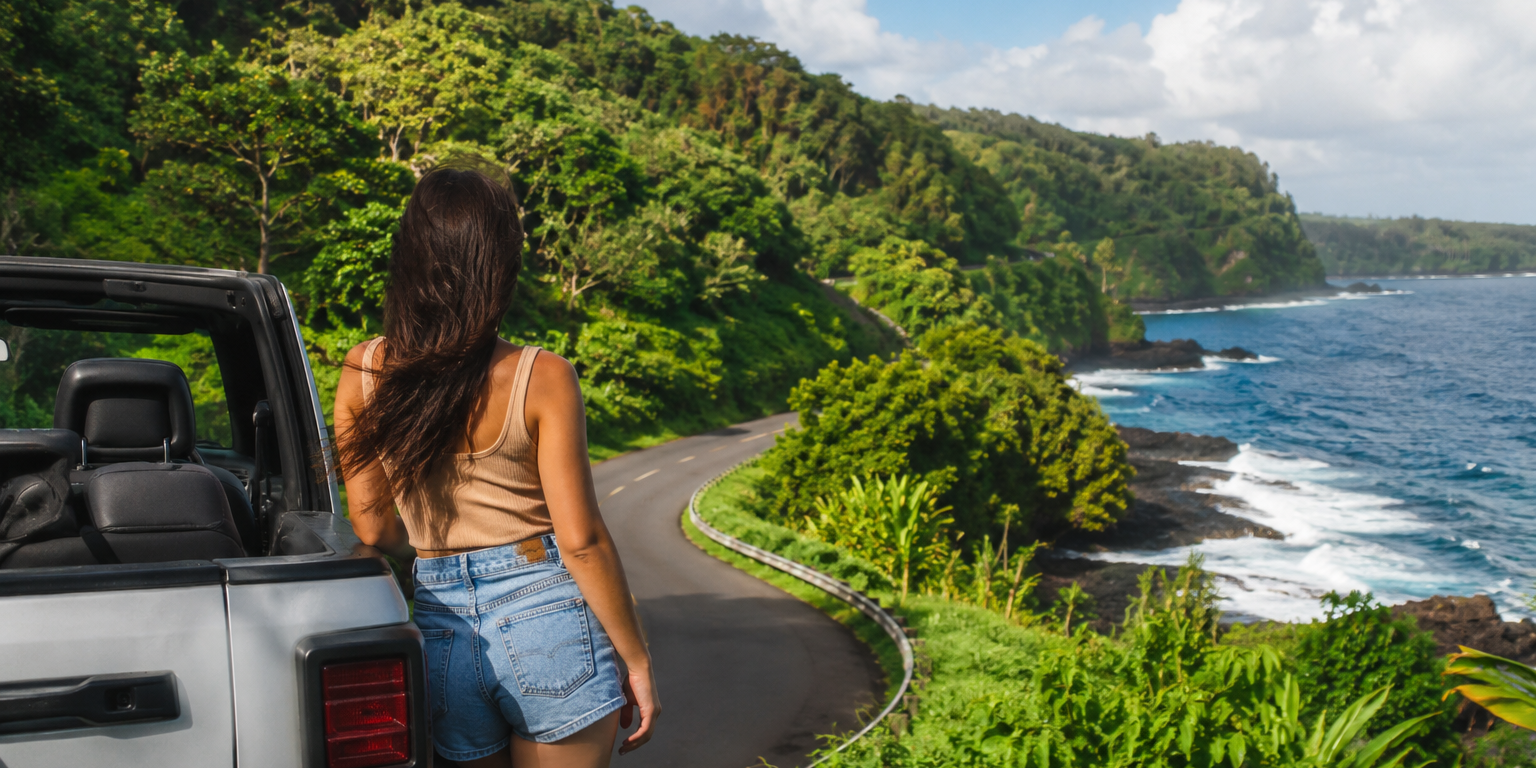
The van slows to a crawl. Outside, a curtain of jungle, impossibly green, hangs over a one-lane bridge. The ocean glitters a thousand feet below. Nobody speaks.
Then your road to Hana guide turns around with a half-smile and says it: “Okay. Here’s the part they never put on the map.”
That moment, that exact pause between the ordinary world and something ancient, alive, and utterly Hawaiian, is what a guide lives for. And if you’ve ever been lucky enough to hear those words on a real guided tour of this island, you know that what comes next changes everything.
“Maui is not a destination. It’s a conversation; between the ocean and the mountains, between the ancient and the alive. My job is to translate.”
Chapter One: Mountain That Swallowed the Sun
Before the first waterfall, your guide turns with an unexpected question: “Do you know why the days here feel longer?”
It’s not the time zone. It’s a promise.
Long ago, the sun raced so fast that fishermen’s nets stayed wet and crops withered. The fearless demigod Maui watched his mother weep over a damp tapa cloth and decided to intervene.
Before dawn, he climbed Haleakalā; the House of the Sun. Armed with a rope braided from his sister’s sacred hair, Maui waited. As the sun crested the crater, he lassoed its fiery rays one by one, holding the star captive until it vowed to slow its pace.
Today, your road-to-Hana guide points to the distant, sleeping summit. Looking at the volcano, geography suddenly transforms into memory. The golden, unhurried light isn’t just weather; it’s the sun keeping an ancient promise.
Road to Hana: 620 Curves and 100 Stories
There are 620 curves on that road. Fifty-nine bridges. Dozens of waterfalls you’ll never find on any map, because they don’t have official names; only the names the locals gave them, which are better anyway.
Chapter Two: Sea That Talks Back
Out on the water, the stories grow older. Long before GPS, ancient Hawaiian navigators crossed thousands of miles of open Pacific using only the stars as street signs, trailing their hands through currents to read the sea.
As your boat glides into Ma’alaea Bay, a humpback whale breaches, shattering the glass-smooth surface. Your road to Hana guide smiles. “They return to these exact waters for millennia,” he whispers. “They don’t need a map; they carry it in their bodies. This ocean is crowded with memory.”
Later, you approach Molokini Crater, a crescent moon of rock rising from the deep. Legend says it’s the tail of a beautiful woman, turned to stone by a jealous goddess. You slide into the water, adjusting your mask. Drifting over centuries-old coral, the myth feels entirely alive.
Everything in Maui has a deep backstory. You need a local guide to tell you.
Chapter Three: Lahaina; Town That Remembers Everything
Walk down Front Street in Lahaina, and you’re walking over history so thick it has layers.
This was the royal capital of the Hawaiian Kingdom. Kings and queens lived and governed here. Whaling ships crowded the harbor in the 1800s; 400 ships in a single season at the height of the Pacific whaling trade. Missionaries arrived, and with them, the first printing press west of the Rockies. The old courthouse still stands near the waterfront.
And at the center of it all, the ancient banyan tree on Lahaina Square. Planted in 1873, it now covers nearly an acre. Its canopy is a cathedral. Twelve major trunks, hundreds of aerial roots, all one single tree.
The 2023 Fires: What the Island Carries
Pausing at Lahaina, your guide’s voice softens. The August 2023 embers changed this royal port forever, yet the aloha spirit never broke. Here, you witness a resilient community rebuilding; proving that Maui’s greatest living legend is its unbreakable heartbeat.
Chapter Four: Stories the Ocean Tells
Not all Maui stories happen on land.
Out on the water, between the islands of Maui, Lānaʻi, Molokaʻi, and Kahoʻolawe, lies the Auʻau Channel, one of the most biologically rich ocean corridors on Earth. Every winter, humpback whales journey over 3,000 miles from Alaska to give birth here. Not because the water is warm. Because it has been their home for millions of years.
Your whale-watching guide crouches at the bow of the boat and speaks quietly, as if not to disturb the ocean itself.
The Hawaiian word for humpback whale is koholā. The ancient Hawaiians believed whales were aumākua, ancestral spirits in animal form. When a pod of whales circles your canoe, you don’t panic. You honor them.
And then, right on cue, as if the island is in on the story, a tail rises from the water, hangs for a breath in the January air, and slips back below without a sound.
Why Hawaiians Consider the Summit Sacred
Haleakalā is not just a volcano to native Hawaiians; it is the dwelling place of the sun, the site of Maui’s greatest legend, and a place of profound spiritual significance. Ancient Hawaiian priests once climbed to the summit for a ceremony. The name itself, Haleakalā, means “House of the Sun.”
Looking out at the crater from the summit, you stand at the edge of something that predates human memory. The landscape looks like the moon. The silence is absolute. And your road to Hana guide, the best ones, at least, will let you stand in it without filling it with words.
Some things don’t need commentary. They need witnesses.
Adventures That Are Waiting for You
To truly unlock these hidden corners of paradise, you need an experienced, top-rated local partner. Stardust Hawaii specializes in turning these iconic landscapes into deeply personal, unforgettable stories.
Whether you’re flying over the island, riding through the jungle on an ATV, drifting below the surface watching a sea turtle breathe, or watching the sky turn pink and gold over the summit, Maui is inexhaustible.
As the island’s premier eco-tour and adventure coordinator, Stardust Hawaii brings you closer to the magic. Here are just a few of the adventures where the stories live:
- In the Air: Helicopter tours, parasailing, aerial views of the Valley Isle
- On the Water: Whale watching, kayaking, snorkeling at Molokini Crater
- Under the Water: Scuba diving, submarine adventures, reef exploration
- On the Land: Road to Hana, ATV tours, Harley rides, Maui Treasure Hunt
And for families, the legendary Maui Treasure Hunt is a guided adventure that turns the island into one giant treasure map for kids. It might be the most fun your family has ever had together.
With industry-leading local road-to-Hana guides, luxury vehicles, and a deep commitment to treating every guest like ʻohana (family), Stardust Hawaii ensures your vacation is safe, respectful, and absolutely magical.
Your Turn to Hear the Story
When you book your adventure with Stardust Hawaii, you aren’t just getting a seat on a bus; you are unlocking the true heartbeat of the islands. As premier road to Hana tour guide, we specialize in premium, small-group experiences led by certified local experts who treat you like ʻohana (family).
Here’s the thing about us: we don’t just know the roads. We know the island the way a family member knows a home.
Every road to Hana tour is a different story. Every group hears something slightly different, depending on the season, the weather, what the guide saw that morning, and what question someone in the back seat asks at just the right moment.
That’s what makes it irreplaceable. That’s what makes Maui worth slowing down for.
And the best place to start? Right where your road to Hana guide leans in, drops their voice, and says those eight words:
“This is the part they never put on the map.”
We’ll be ready when you are. Book the road to Hana with Stardust Hawaii now!
FAQs
What is the best guided tour in Maui for first-time visitors?
The Road to Hana guided tour is the most essential Maui experience for first-timers. This full-day journey navigates 620 curves and 59 bridges through pristine rainforests. Stardust Hawaii, a trusted TripAdvisor award-winner since 2012, offers premier Hana tours alongside unforgettable helicopter, snorkeling, ATV, and seasonal whale-watching adventures.
What stories do Maui tour guides tell tourists?
Maui guides share ancient Hawaiian legends, history, and cultural traditions. You will hear how the demigod Maui lassoed the sun at Haleakalā, learn about Pele’s volcanic creations, and discover Lahaina’s history as a royal capital. Guides also share intimate stories of generational local families and the community’s resilient recovery.
What is the best time of year to take a Maui tour?
Maui is spectacular year-round, but timing depends on your goals. December through April is peak whale-watching season. April to June offers incredibly lush landscapes, while July through September brings dry, ideal weather for hiking and snorkeling. Haleakalā sunrise tours remain completely magical and highly popular year-round.
What is Haleakalā, and why do tourists visit the summit?
Haleakalā is a massive 10,023-foot shield volcano, meaning “House of the Sun.” Tourists visit its summit to witness world-famous sunrises above the clouds and explore an otherworldly, Mars-like volcanic crater. It is also home to the rare silversword plant, which blooms brilliantly just once before dying.