
You’re driving along a cliffside road in Maui, jungle on one side and ocean crashing below on the other. Then, out of nowhere, the road narrows to a single lane. A car is coming straight at you. There’s no light, no sign, no rulebook taped to the dashboard. Just you, a stranger in another car, and about fifty-four moments like this waiting ahead of you.
This is the reality of the Hana Highway, and it catches almost every first-time visitor off guard. Most people planning a Road to Hana Maui tour trip spend hours researching waterfalls and lunch stops, but almost nobody researches the bridges. That’s a mistake, because the bridges are where trips actually go wrong: awkward standoffs, honking, and long backups that eat into your day.
This guide breaks down exactly how bridge etiquette works on this famous drive, why it matters more than people think, and how a guided road trip to Hana with Stardust Hawaii takes that whole headache off your plate. We’ll also cover the best waterfalls on the road to Hana so you know exactly what you’re driving toward.
What Makes the Road to Hana’s Bridges So Unique?
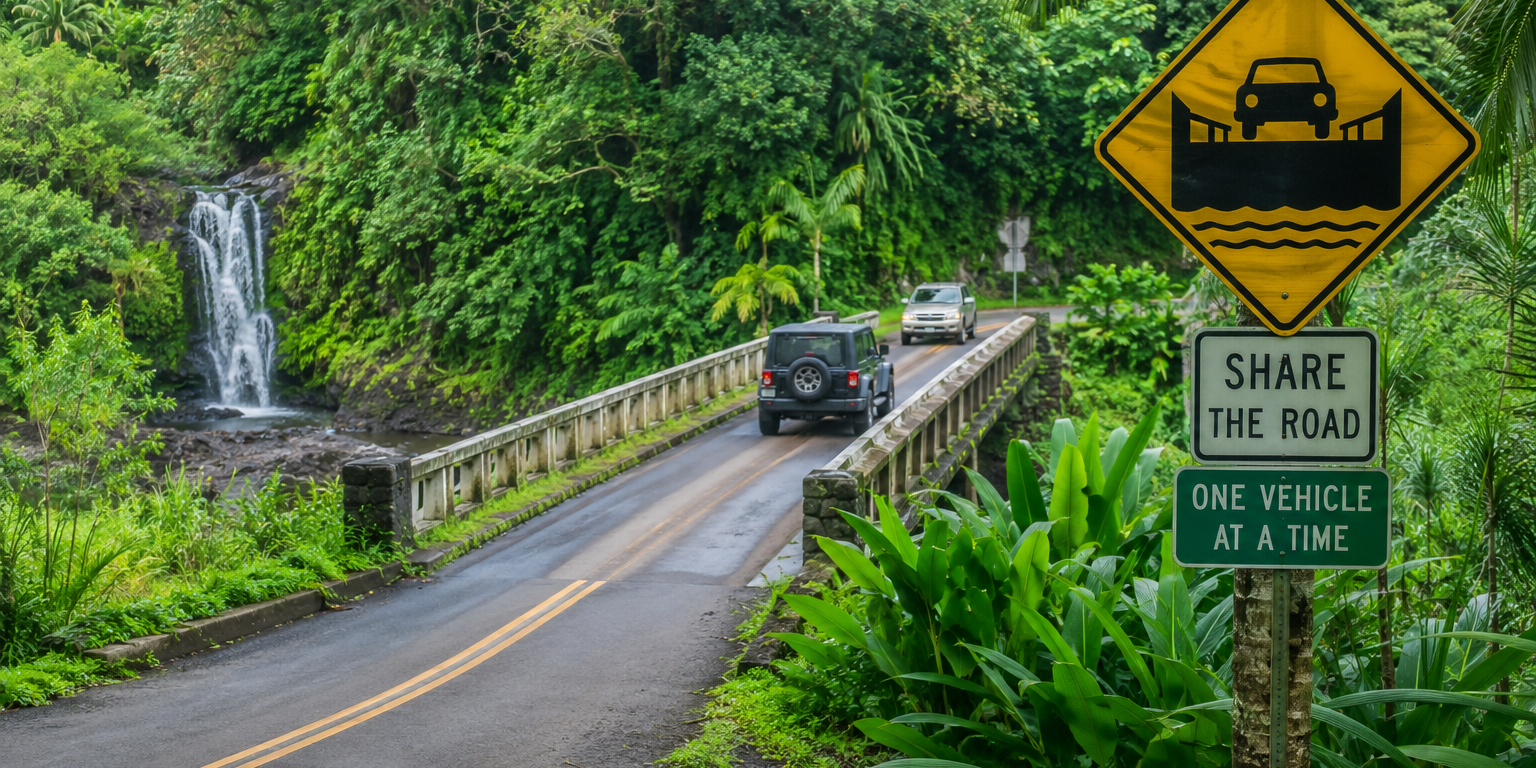
The Hana Highway stretches about 64 miles along Maui’s northeast coast, and along the way, drivers cross 54 one-lane bridges. That’s not a typo. The Hana Highway attracts 1.5 million to 2 million visitors each year. Fifty-four times, two lanes of traffic have to squeeze into one, usually with a jungle canopy overhead and a river or waterfall running underneath.
Most rental car companies won’t mention this. Your GPS app definitely won’t warn you either. It just routes you straight through without a heads-up, so people end up learning the rules in real time, usually while three cars are already backed up behind them.
A Quick History of the Hana Highway’s Bridges
The road itself recently marked close to a century since it was finished, built back when cars were smaller, and traffic was rare. Engineers at the time weren’t planning for tour vans and rental SUVs meeting nose to nose every few minutes.
The bridges were built narrow because that’s all the road needed back then. Nobody ever widened them, partly because of the terrain, and partly because locals like the road just the way it is. That history is part of the charm, but it’s also exactly why the etiquette matters so much today.
The Unwritten Rule of Road to Hana Bridge Etiquette
Here’s the rule almost nobody tells you before you land in Maui: locals use an informal system where about five or six cars from one side cross the bridge, and then it’s the other side’s turn. Nobody wrote this down anywhere official. There’s no sign posted. It’s just something everyone who drives this road regularly understands, and it keeps traffic moving instead of grinding to a halt.
The problem is tourists don’t know this system exists. So they either stop dead in confusion, waving the other car through out of politeness even when it’s clearly their turn, or they push through aggressively and cut off five cars that were already patiently waiting. Both reactions cause backups, and both can frustrate the locals who use this road every single day for actual errands, not sightseeing.
Right-of-way generally works like this: whoever reaches the bridge first, or whoever has the clearer path, usually goes first. But when it’s unclear, a small wave or a flash of the headlights communicates “go ahead” faster than any awkward staring match ever will.
Common Mistakes Tourists Make on One-Lane Bridges
A few habits show up again and again on the road to Hana Maui, and they’re easy to avoid once you know about them:
Stopping in the middle of the bridge for photos. It’s tempting, but it blocks everyone behind you.
Hesitating too long. Indecision causes more backups than actually going.
Ignoring the driver on the other side. A simple wave says thank you and keeps things friendly.
Rushing through without checking. Some bridges curve, so you can’t always see oncoming traffic until you’re already committed.
Bridge Etiquette Quick Reference
| Situation | What To Do | What To Avoid |
|---|---|---|
| Car waiting on other side | Let 5–6 cars pass, then yield | Cutting in line |
| You’re mid-crossing | Keep moving steadily | Stopping for photos |
| Uncertain who goes first | Flash lights or wave to signal | Sitting still, blocking flow |
| Local driver behind you | Pull over when safe to let them pass | Blocking faster local traffic |
Why a Guided Road Trip to Hana Takes the Stress Out of Bridge Navigation
Here’s the truth: reading about bridge etiquette is one thing, but doing it calmly on the road to Hana Maui Tours while also watching for waterfalls, one-lane curves, and your GPS all at once is a lot for one driver to handle. This is exactly where a guided tour changes the entire experience.
With Stardust Hawaii, your driver already knows this road inside and out. They’ve crossed these same 54 bridges more times than they can count, and they know exactly when to go, when to wait, and how to keep things moving smoothly without any awkward standoffs.
Locals sometimes call these experienced drivers “bridge whisperers,” and honestly, that nickname fits. While a self-driving tourist is white-knuckling their way through blind curves, you’re sitting back, sipping coffee, and watching the jungle roll by.
Guided vs. Self-Drive: Which Fits Your Trip?
Both options can work, but they fit different kinds of travelers. If you love total control over your schedule and don’t mind the mental load of navigating unfamiliar roads, self-driving might appeal to you. But if you’d rather relax, learn the local history, and skip the stress of narrow bridges and tricky parking, a guided tour is the easier choice.
Guided Tour vs. DIY Road to Hana Drive
| Factor | Guided Tour | Self-Drive |
|---|---|---|
| Bridge navigation | Handled by expert driver | You navigate solo |
| Parking/reservations | Pre-arranged | Your responsibility |
| Local knowledge | Included (history, stories) | Self-researched |
| Stress level | Low | Moderate to high |
| Flexibility | Set itinerary | Fully customizable |
The Best Waterfalls on Road to Hana (And How Bridges Lead You There)
Almost every bridge on this drive leads you closer to something beautiful, and that’s really the whole point of enduring the narrow crossings. Here are some of the best waterfalls on the Road to Hana that make the whole trip worth it:
- Twin Falls: an easy early stop, great for warming up before the real adventure begins.
- Waikamoi Falls: a quick, scenic pull-off surrounded by dense jungle.
- Upper Waikani Falls: often called the “Three Bears” because of its three cascading tiers.
- Pua’a Ka’a Falls: one of the few spots where swimming is actually allowed when conditions are safe.
Which Waterfalls are Worth the Stop?
Not every waterfall along the way is safe to swim in, and some require a short hike to reach. If your time is limited, prioritize Pua’a Ka’a for swimming and Upper Waikani for photos. A knowledgeable guide can tell you which spots are actually open and safe on the day you visit, since conditions change with rain and water flow.
Tips for a Smooth Road Trip to Hana Beyond the Bridges
A few small habits make a big difference on this drive. Start early, ideally before 7 a.m., since traffic and parking get difficult fast once the day gets going. Fill your gas tank in Pa’ia before you begin, because there are no gas stations for the next fifty miles. And always check current conditions before swimming anywhere, since waterfalls can get dangerous after heavy rain.
Ready to Experience the Road to Hana Without the Guesswork?
The bridges are just one small part of what makes this drive unforgettable, but they’re also where most self-driving trips hit a snag. If you’d rather skip the guesswork and let someone else handle the curves, the bridges, and the timing, Stardust Hawaii’s guided tour covers it all: the best waterfalls on Road to Hana, lunch, and every one of those 54 crossings handled by a driver who knows this road like the back of their hand. Book your seat with Stardust Hawaii today and turn your Road to Hana Maui Tours into the easiest part of your Maui vacation.
FAQs
Q1. How many one-lane bridges are on the Road to Hana?
Ans. There are 54 one-lane bridges along the Hana Highway, which is part of what makes this drive so unique and occasionally tricky for first-time visitors.
Q2. What is the unwritten bridge rule on Road to Hana?
Ans. Locally, drivers follow an informal system where about five or six cars from one side cross before yielding to the other side. It’s not official, but it’s widely understood and keeps traffic flowing.
Q3. Is it better to drive the Road to Hana myself or book a tour?
Ans. Both work, but self-driving means learning bridge etiquette and navigation on the fly, while a guided tour lets an experienced driver handle it all so you can relax and enjoy the scenery.
Q4. What are the best waterfalls to see on the Road to Hana?
Ans. Twin Falls, Waikamoi Falls, Upper Waikani Falls, and Pua’a Ka’a Falls are among the most popular stops, with Pua’a Ka’a being one of the few reliably safe places to swim.